
The Virleandri Canons are a set of three Canon a 2 for solo piano by Nick Peros. The three canons are as follows –
Virleandri – Canon I
In Retrograde – Canon Cancrizans
The entirety of Voice 2 (piano left hand) is the whole of Voice 1 (piano right hand) played backwards against itself – if you play the last bar of the Left Hand, backwards, it will be exactly the same as the first bar of the Right Hand, forwards – and so it continues for the entire Canon.
Virleandri – Canon II
In Mirror – Canon Motu Contrario
The entirety of Voice 2 (piano left hand) is the whole of Voice 1 (piano right hand) turned upside down and played upside down against itself (Voice 2 is an exact Mirror of Voice 1)
In a Mirror Canon, Voice 2 is not a general Inversion of Voice 1, but rather is an exact Mirror of Voice 1, in that the quality of the opposite interval remains exactly the same.
In a straight Inversion, Voice 1 may rise a sixth, and so Voice 2 falls a sixth – but the rise might be a major sixth, while the fall might be a minor sixth, so the quality of the intervals is not the same.
In a true Mirror Canon, the quality of the rising interval must be exactly the same as the falling interval – if Voice 1 rises a major sixth, then Voice 2 must fall exactly as a major sixth.
Canon II is a strict Mirror Canon.
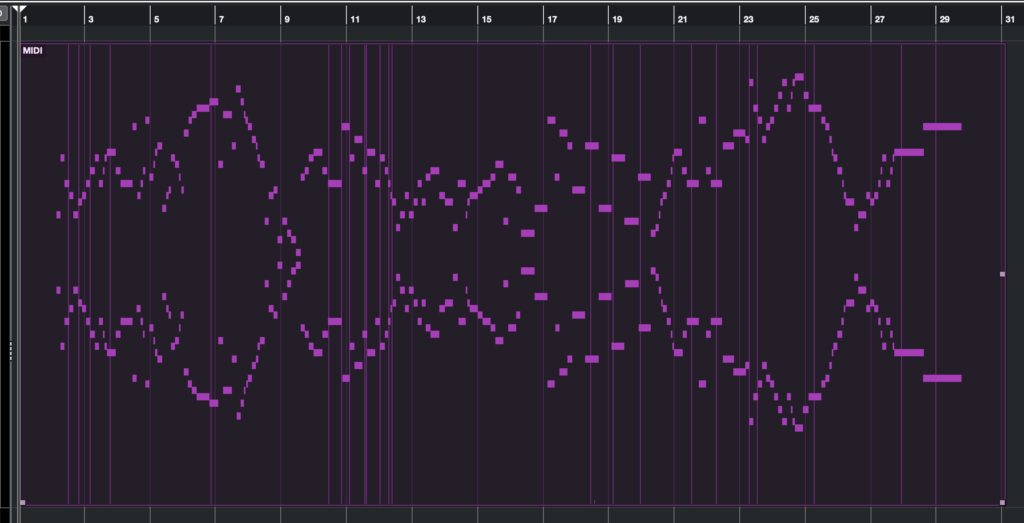
This is a studio screenshot of the note mapping of Canon II – the top half of the image is the piano right hand, the bottom half of the image is the piano left hand – the piano left hand is an exact mirror/reflection of the piano right hand
Virleandri – Canon III
In Mirror and Retrograde – Canon Motu Contrario e Retrogrado
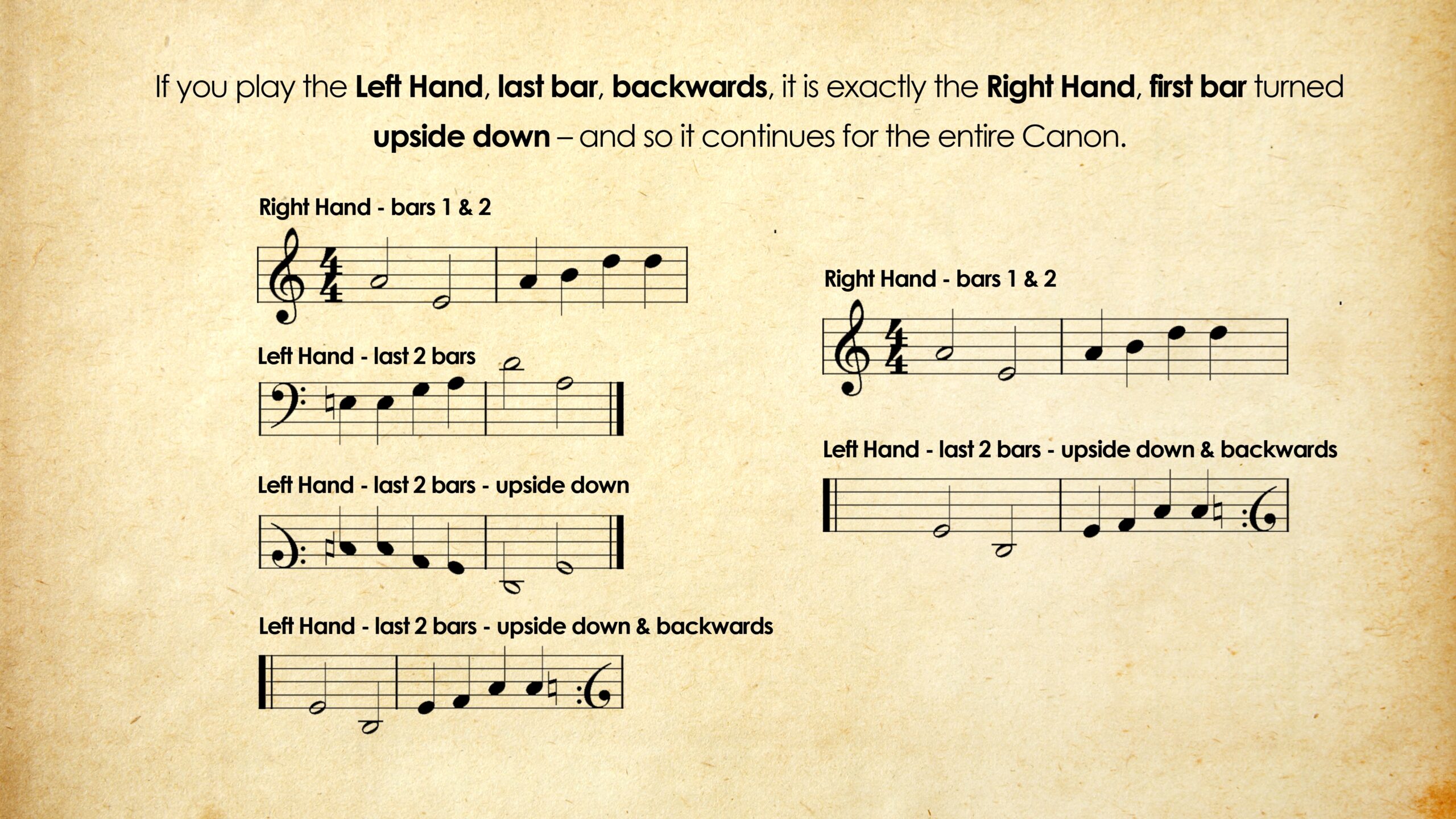
The entirety of Voice 2 (piano left hand) is the whole of Voice 1 (piano right hand), first, turned upside down as an exact Mirror of Voice 1, and then that upside down Mirror is played backwards against the whole of Voice 1 – Voice 2 is simultaneously an exact upside down Mirror of Voice 1, playing backwards against Voice 1 -– if you play the Left Hand, last bar, backwards, it is exactly the Right Hand, first bar turned upside down – and so it continues for the entire Canon.
In this Canon III, Bar 39 is the pivot bar – this is where the two Voices converge & cross paths. Since that is the Pivot point, that one bar is then a Mirror & Retrograde of itself – in that bar 39, Voice 1 rises a minor third going forward, while Voice 2, going forward, falls a minor third, and so Voice 2 is an exact Mirror of Voice 1; in that same bar 39, going forward, Voice 1 rises from an Eb to an F#, while, in that same bar & going backwards, Voice 2 also rises from an Eb (D#) to an F#, and so Voice 2 is an exact Retrograde of Voice 1 – after which, in both forward & backward directions, the two Voices continue in an exact Mirror & Retrograde.
In this Canon III, the first note/beat 1 of Voice 2/piano left hand, in bar 46, the Eb, is voiced an octave lower, and this for the sake of variety of pianistic colour.
Enharmonic spelling is used throughout for ease of performance / sight-reading.
In a Canon that is both Mirror & Retrograde, the challenge is to achieve musicality and expression, despite the restrictions imposed by the form.
THE TITLE – VIRLEANDRI
The name of this set of three Canons – “Virleandri” (pronounced “veer-lee-ANNE-dree”) – was inspired by a special family friend. Our very good friend Leandri has a love for music and especially piano music. In the course of a musical talk, the topic of Beethoven’s “Fur Elise” came up, which work is one of Leandri’s favorite pieces. In the musical kidding around that ensued, I mentioned that I should write a work for piano and call it “For Leandri”. It was soon afterwards that I had the idea for the three Canons, and I decided that, born out of our musical kidding around, the title for the set would be “For Leandri”. Since Leandri’s background is Afrikaans, the Afrikaans translation of “For Leandri” is “Vir Leandri” – and so, from that Afrikaans translation, comes the title for this set of three Canons – “Virleandri”.
Canon III – the Subject
The first seven notes of the Right Hand (bars 1 – 3) are the Subject/Theme for Canon III, with that subject characterized by the leap of one half note to another half note, and also by the ensuing repeated notes followed by a leap.
Those seven notes were in fact a prerequisite for Canon III, as they, by referring to various cultural musical nomenclatures, musically spell out the name Leandri, as follows.
By referring to standard Western musical nomenclature, as well as to Solfege, Indian Sargam and Boethian, the first seven Right Hand notes of Canon III spell the following:
A – La (solfege)
E – E (western)
A – A (western)
B – N (Ni in Indian Sargam)
D – D (western)
D – Re (solfege)
F – I (Boethian) *
* This equating of “I” with the Western note “F” is as per certain summaries of Boethian musical nomenclature; it is generally accepted that the Boethian “I” in fact equates to the Western note “B” – however, for this Canon III, it is considered that “I” equates to the Western note “F”.